
About PETA Prime
Are you ready to make a big difference for yourself, animals, and the Earth through simple day-to-day choices? PETA Prime has all the information you need to live a healthy, humane, and rewarding life.

 
Recipes Pledge To
Be Veg
For 30
Days
Certified Best in America by Independent Charities of America

Family & Friends

  • Feb
  • 5

Cats and Their Claws

Posted by Ingrid Newkirk at 5:52 AM | Permalink | Comments (13)


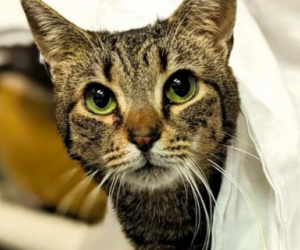
catclawsGinger, the world’s cutest overgrown kitten, is up against the fabric wallpaper again, stretching like a yoga teacher, her back arched, her legs thrust as far up the wall as she can reach. I know she’d have that wall looking like frayed jean bottoms if I hadn’t clipped her nails this week, but I did, so I don’t have to bite my nails over her wild (and healthy) calisthenics!

Cats have to scratch as surely as birds gotta fly, for reasons buried deep in their psyches, like marking territory, as well as for play, exercise, and nail conditioning. However, rather than take a hatchet to a hangnail and remove kitty’s claws (and ligaments, muscle, and bone, for that is what happens in “declawing” surgery), there are simple, noninvasive solutions to worries about the furnishings. Those solutions, unlike declawing, do not lead to “out of litter box” experiences, neuroses, and spinal problems. Of course, if everything must be pristine and perfect, a house isn’t a home for any living being!

Kind veterinarians will not declaw. As Dr. Nichols Dodman of Tuft’s University School of Veterinary Medicine says, “Declawing is abhorrent and inhumane,” and as Dr. Louis J. Camuti, who has practiced veterinary medicine for 40 years puts it, “I wouldn’t declaw a cat if you paid me $1,000 a nail.” Declawing is illegal in England because it is cruel, and it should be here, too, but commerce sometimes gets the better of compassion.

The reasons not to declaw are too numerous to count on one paw. It can make cats who were once full of life lifeless, withdrawn, and upset, and you will not be able to turn back the clock. Also, cats naturally walk like ballerinas on their “points,” but declawing throws them off balance, forcing them to learn to walk in a very different way, which can cause irreparable and painful damage to the spine.

Some cats become so shell-shocked by the experience, and upset by the pain in their feet or memories of it post-surgery, that they will no longer use the litter box, a problem that far outdoes any damage they can do to a curtain. They can also feel betrayed by the realization that the person they thought loved them has removed a vital part of their very being. There are other problems that arise from declawing, but suffice it to say that alternatives to declawing are the only things acceptable to a kind cat companion.

Here’s how to avoid tatters:

It is the little hook on the end of your cat’s nails that is responsible for pulling threads and tearing at things, so that hook has to be worn down or snipped off. Then, bingo, the problem is solved.

1. Get as many scratching posts as you can (the horizontal ones work as well as the vertical), trying different surfaces and styles. Put catnip on them once in a while to make them super-inviting. Don’t just buy ones at the store; try to pick up the occasional log, the taller the better, or a large fallen branch. Shake it out well to dislodge insect life, then leave it outside, in the sun if possible, and up off the ground on a piece of newspaper for a couple of days, just to be extra sure. Make sure any log you bring home is anchored so that it can’t fall on your cat while being used.

2. Smear a little cologne or flea dip on any fabric area where you do not want your cat to scratch. Sometimes covering a piece of furniture temporarily with contact paper or something else that’s slippery, will stop the behavior.

3. If you have a steady hand and good eyesight, buy a pair of cat nail clippers and use them. Gently squeeze each nail out, look for the quick (this is vital), and snip the hook off only, just above the quick. If you are unsure, go to a gentle veterinarian or groomer and insist on staying with your cat while his or her nails are clipped.

-excerpted from Making Kind Choices: Everyday Ways to Enhance Your Life and Avoid Cruelty to Animals

Posted to Family & Friends | Posted to Tags: ,

More:

Bookmark and Share
13 Comments

Subscribe to this post's comment RSS.

    Susan Hargreaves says...

    February 5th, 2009, 2:27 pm

    Good Advice Ingrid, especially the bit about staying with your cat when the vet or groomer is clipping their nails. Beware of the groomer who tells you that you cannot be with your cat at nail clipping time. Thank you.

    Gary says...

    February 6th, 2009, 3:47 pm

    Thank You, as these are excellent suggestions.
    I also find white pepper useful in keeping Animals away from some objects, like houseplants that aren’t good to spray chemical repellants on.
    I have never clipped an Animals nails, however I do nail care. When it is time to clip and file my own nails, I sit on the floor with some treats and call my Cat or Doggie, and they watch while I do my nails. After I have done my nails, I take “their” file and file and buff their nails. My Animals look forward to this “pampering”, and I get little flurries of “kisses” in between paws.
    Thank You for reading.
    Gary
    in Tampa

    Monica says...

    February 6th, 2009, 4:11 pm

    Thankyou so much for writing this article, I am originally from England and I had never seen a declawed cat till I moved to Canada, I try to explain to people that they do not have to resort to this horrible procedure of declawing so I will be forwarding your information to everyone I know,
    I have 17 indoor cats and a house full of antiques so I am living proof that you can live with your pets without doing this horribly invasive surgery,
    Monica in Canada

    Cerissa Mellinger says...

    February 6th, 2009, 4:41 pm

    I would never declaw any of my animals. I knew it could lead to stress problems and hurt their paws, but I didn’t know it could cause spinal damage to the cat. It doesn’t surprise me the hear that though; It makes logical sense. That’s very similar to Chinese foot binging of women. It makes the woman unable to walk properly because a humans toes and foot needs to be the right size and properly developed in order to walk correctly. If not it can be very stressful to walk on the feet, and lead to other damage of bones in the woman legs and body. For example, loss of bone marrow and muscle strength in the legs from the lack of not being able to walk often and correctly. I don’t see how it’s humane to declaw a cat, dog, or any animal if it harmful to do something similar to a human. I try to encourage people I know not to declaw their animals. Hearing this bit of information, I will make sure to be stronger in encouraging anyone I know not to declaw their cat and let people who have declawed know what effects can be caused to their pet, in hope they will pass the information on and use it in the future.

    Best wishes to every animal and every animal friendly person - From Pittsburgh, PA

    Jadey says...

    February 6th, 2009, 7:14 pm

    Thanks for this article, I’ll have to show it to some of my friends who think that declawing is vital maybe they’ll understand that I’m not insane (none of the cats who live with me are declawed my arms and thighs are often full of scratches (thanks to Miss panic at the disco who shows her affection trough scratching) my faux leather chairs now look horrible (thanks to Gollum aka Pimp who prefer my chairs over any scratching posts) but hey scratches on my skin will heal (hopefully Miss panic at the disco will grow out of her ”loooooooooooooooooook I’m purrrinng and scraaaaaaaaaaaaaaatching on your shoulderrrrrrrrrrrs”) and the chairs who care about chairs when you can have an happy cat? Plus I wouldnt want any of them to lose their personalities… Maybe they’ll believe it if it doesnt come from me :)

    G Baker says...

    February 6th, 2009, 10:20 pm

    While grotesque, there are good reasons as well to have this done. We have adopted cats with blood borne illness and it has protected them as well as the cats we already had. I’d rather a cat loses his claws and gain a home for life than die in a pound or on the street.

    If it is done correctly and when they are young there aren’t many complications. My family has had over 20 declawed felines over the years and none of this has proved true in our case. There have been no personality changes, no back problems and most were playing the next day. All these cats are happy, content, well taken care of and frankly do not seem to be bothered. I must say, *in my experiance,* this is a RISK that needs to be taken into account but doesn’t happen quite like it’s been stated.

    By the way, my cat has all his toes.

    cassy says...

    February 7th, 2009, 6:50 am

    de clawing cats dogs or any other animal is horriffic i would no way in hell do this and no sane person would how would cus humans like to be declawed / have our nails taken out oh the pain its just the same as declawing no thanks

    Natalie says...

    February 7th, 2009, 3:15 pm

    Just about a week ago I saw an ad for a product that could be another great alternative for problem cat scratching- I have never tried it and don’t know much about it, so I’ll leave it up to you guys to say whether it’s a safe & beneficial solution.

    It’s these tiny, clear plastic “caps” that are shaped like a cat’s nail, that come with a little adhesive glue to cover the nail. The ad says to first trim the nail (clip off the hook), and then carefully put a dab of the glue into the nail cover, and place it on the nail, while gently holding the cat and nail cover in place a few seconds to be sure it dries in place properly.

    The product is intended for allowing the cat to scratch away, but to do so without damaging household items like furniture, because the plastic cap is smooth and will glide down objects rather than tear into them. I believe each set lasts about a month. I’m not sure if this would be worth the hassle or not.

    Has anyone heard of this or tried it? Thumbs up or thumbs down?

    jennae says...

    February 7th, 2009, 5:04 pm

    When my house burned down four years ago, my cat and two kittens and I had to live with my parents for seven months. My furbabies were confined to one room, and dispite trimming, and nail covers, they were destroying the room. The ultimatum was we all get kicked out on the street, or the cats claws had to go.

    It was an incredibly difficult decision to make for me. I worked for a vet, and knew the adversity to being declawed. It is terribly inhumane. But it was also the middle of a hard winter (I live in Vermont) and so, talking to my boss, we decided to go ahead.

    My cat was very miserable, and it took her months to recover. The male kitten was prancing around the second day like nothing happened. The female kitten died the next morning.

    I felt so guilty, and was so heartbroken…I had ruined my cats lives, and even killed one of them (and she did suffer before she died) and will never ever forgive myself. I still have the two remaining cats, and love them more than ever. And, as all animals seem to do, they still love me…
    unconditionally, despite what I put them through.

    Looking back, I think I would have rather lived in my car than have put them through that. Please people, Listen to Ingrid, and use alternatives. You will save your furbabies from terrible suffering, and save your concience. I thought of it in another way….would you ever think of declawing your dog??? Of course not!

    Pamela says...

    February 7th, 2009, 9:11 pm

    Thank you for a humane and informative article. I cannot abide any person who would be so lazy and selfish as to declaw their cats for any reason. No piece of furniture is more valuable than a living animal. If you love antiques that much, find good homes for your pets because you have no right to have one.

    Jackie says...

    February 8th, 2009, 10:41 am

    I have had many cats in my life, and I’ve never declawed any of them. How would you like having your nails and end of fingers cut off? Very painful and something you’d never forget. Thanks for this article. I hope it deters some cat owners from declawing their cats.

    karma says...

    February 8th, 2009, 6:37 pm

    what about soft paws (the plastic claw covers)? i have been using these on my cats and haven’t heard anything “bad” about them, just curious if anyone has heard or knows any repercussions to them.

    Ana says...

    February 12th, 2009, 10:42 am

    G Baker, declawing is indefensible. Paws come with claws; you would never think of amputating your own fingers so cats should not suffer such an evil and painful fate. If the vets didn’t make money on declawing they wouldn’t perform it. Many countries in Europe prohibit this totally unnecessary amputation based on its cruelty and that it provides absolutely no benefit for the cats. The argument that cats would end up in the streets if not declawed is a specous one. I have rescued many declawed cats on the streets thrown out after their novelty has faded for the humans. There are also many cats in shelters that were given up as well. What happened to their guaranteed for life home when declawed????
    If paws with claws is a problem for anyone get a pet rock.
    jennae, I sympathize with your circumstances and I am sorry that you felt compelled to do something against your own wishes.

    Paws come with claws, don’t declaw!!!

Post a Comment

Please keep comments polite, constructive, and on topic. All fields in bold are required.


About Friends & Family

Make your time with your friends and family—including your animal companions—even more meaningful.

Most Popular

Recent Comments

Archives

Subscribe to PETA Prime

Disclaimer

The information and views provided here are intended for informational and preliminary educational purposes only. From time to time, content may be posted on the site regarding various financial planning and human and animal health issues. Such content is never intended to be and should never be taken as a substitute for the advice of readers' own financial planners, veterinarians, or other licensed professionals. You should not use any information contained on this site to diagnose yourself or your companion animals' health or fitness. Readers in need of applicable professional advice are strongly encouraged to seek it. Except where third-party ownership or copyright is indicated or credited regarding materials contained in this blog, reproduction or redistribution of any of the content for personal, noncommercial use is enthusiastically encouraged.