Written by Jeffrey Spitz Cohan, senior philanthropic specialist with the PETA Foundation.
When Pope Gregory I, way back in the Sixth Century, put forth the concept of the Seven Deadly Sins, he was clearly lacking a good editor.
There is an Eighth Sin, or a sin that encompasses all of the other seven, that is conspicuously and obviously missing from the Pope’s list– denial.
The fuel of denial powers greed, lust, sloth, and all the other sins. Only by lying to ourselves, or willfully fooling ourselves, can we continue to hurt ourselves and hurt animals.
The thought struck me during my recent encounter with Ignatius J. Reilly, one of the most memorable characters in modern literature. The protagonist of John Kennedy Toole’s Pulitzer Prize-winning novel Confederacy of Dunces, Reilly lives with his mother, subsists on junk food, abhors working for a living, and harbors grandiose illusions about his literary future.
The novel is a dark comedy. When I wasn’t laughing, I was wincing. Reilly’s state of denial is bigger than Texas. He is out of touch with reality, much to his own detriment, and to those around him. Toole, I strongly suspect, created Reilly to lampoon bibliophiles and possibly himself. But maybe Reilly is also meant as a warning about the dangers and the seductiveness of denial.
We are all susceptible to it and guilty of it. It is a wily devil, able to insert itself into our lives in all sorts of situations.
This idea certainly applies to people who abuse, oppress, mutilate, and kill animals.
Take, for instance, Miriam Cabas, a female bullfighter who was the subject of a flattering profile in The Atlantic.
The article, without finding anything amiss or problematic, reported that “Cabas triumphed that day, killing two bulls and receiving three of their ears as trophies. It was the first time she had fought animals antagonized by picadors, men on horseback who stab the bulls with lances.”
If that wasn’t bad enough, consider this quote from Cabas, delivered without a hint of irony:
“Nobody loves bulls like us,” she said. “We devote our lives to them. If that’s not love, then what is?”
If that’s what love is, whatever you do, do not love me. I beg you.
Back to our original point, Cabas and The Atlantic are in denial, to state the obvious.
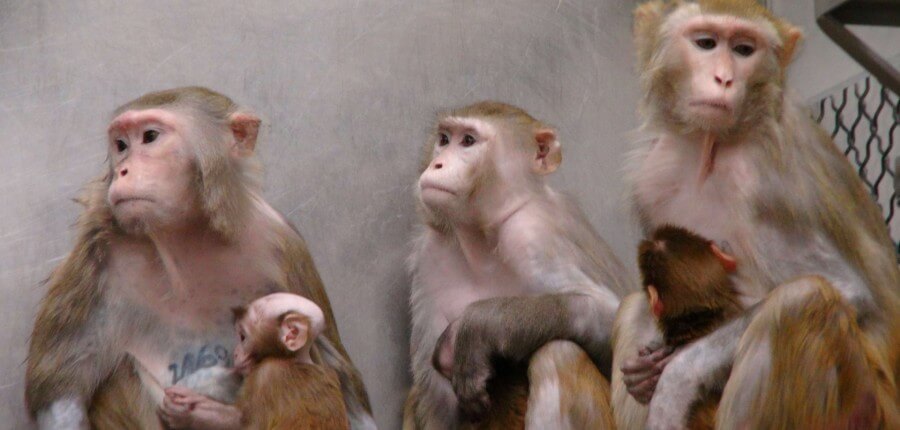
Denialism was also rampant at the annual conference of a national organization of scientists who shamelessly promote experimentation and testing on primates.
I was at the conference, and I can tell you it was absolutely chilling to be sitting among hundreds of people who do unthinkable things to monkeys. Chilling, in part, because those people looked so darned normal.
When they’re not drilling holes in the heads of macaques, I’m sure they’re coaching Little League teams, paying their taxes, and loving their children and partners. But their denialism enables them to torture our closest evolutionary cousins without a second thought.
Surely, more of these researchers know that PETA scientists and others have developed a large suite of high-tech, animal-free testing methods. But, as the muckraking, turn-of-the-century journalist Upton Sinclair famously observed, “It is difficult to get a man to understand something, when his salary depends upon his not understanding it.”
Permit me to gently point out that each of us, you and I, is also vulnerable to falling into a state of denial.
For most of my life, I was eating every kind of animal in sight. I remember ordering rabbit at a trendy California cuisine restaurant; when my dinner came, there was a complete rabbit corpse on my plate. Even that wasn’t enough to pierce through the fog of denial.
Finally, 17 years ago, the lightbulb went on (thanks to Jonathan Safran Foer’s Eating Animals). I went vegan, and I always will be.
So how do we escape this deadly spiral of denialism?
Our salvation starts with clear-eyed and concentrated contemplation, preferably on a meditation cushion. Closely examine everything you’re doing – or not doing – for evidence of denialism. To help you, PETA has created a meditation app.
Once you’ve completed that step, no need to beat yourself up. Repent and atone, if the situation calls for it. But most importantly, just change. Hey, it’s a New Year. What a propitious time to make positive changes in our lives!
PETA offers a wealth of resources to help you remove animal products from your kitchen, wardrobe, and bathroom.
If you need an extra shove to get started, try reading Confederacy of Dunces. You’ll laugh a hundred times. It is a comedy, after all. But you’ll see the ultimate manifestation of denialism in Ignatius J. Reilly, who might be a mirror of ourselves, albeit in exaggerated form.
We’re not Ignatius, just yet. But let’s nip this denialism thing in the bud, shall we?